A job application photo is a file now, and its format is not square
Recruiters review applications on screen, so the file makes the first impression. Use portrait format for application documents and square for profiles.

What file format, size and resolution should a photo for an online job application have, and where in the application does it go?
Use JPG, about 3:4 portrait, around 600 × 800 px for screen-only applications, and 300 dpi for possible printing. Stay under 1 MB, or 200 to 500 KB inside a PDF. These are practical recommendations, not an official standard; the portal's own rules come first.
Place it at the CV header’s top right or on a cover page. Use the portal’s photo field when provided; for email, embed it in the PDF.
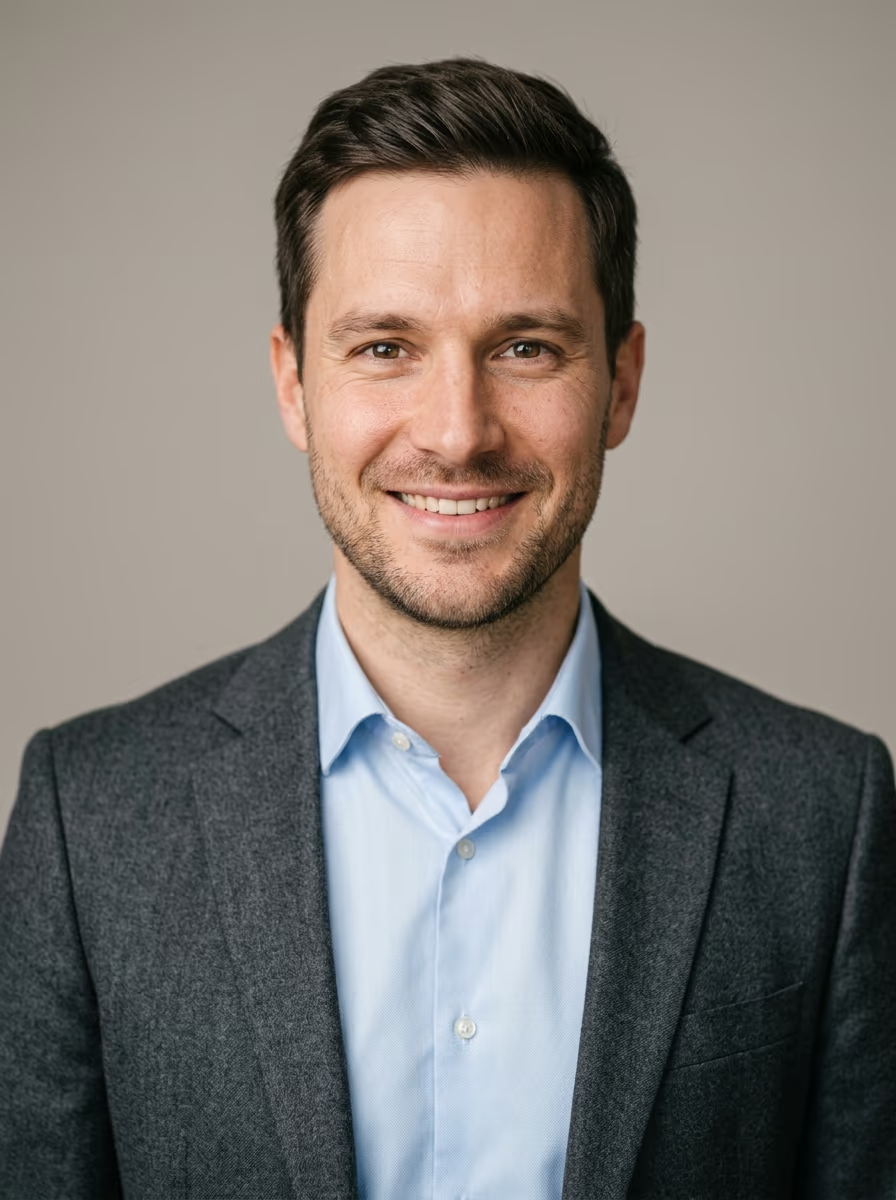
The same face needs a different crop for each destination. Square, about 600 × 600 px, is the usual profile-picture format.
| Value | Recommendation | Why |
|---|---|---|
| File format | JPG; PNG only if requested | Small, widely readable files |
| Resolution | 300 dpi | For printing; less suffices onscreen |
| Pixel size | About 600 × 800 px | Sufficient for screen-only applications |
| Aspect ratio | Portrait, about 3:4 | Matches roughly 4.5 × 6 cm |
| File size | Under 1 MB; 200 to 500 KB inside a PDF | Keeps uploads manageable |
| Background | Neutral and light | Keeps attention on your face |
| File name | Lastname_application-photo.jpg | Helps HR match the file |
If a portal specifies different values, those win. See exact CV photo dimensions in centimeters and pixels.
Header or cover page
Place it top right or alone on a cover page. Embed it firmly in the PDF to prevent shifting.
Check the upload field
Many employers and job boards provide one with a size limit. Upload separately or within the CV.
Send one PDF
Do not attach the photo loose. Embed it for one clean file.
Four mistakes that cost the first impression
A file of several megabytes can exceed portal limits and bloat your PDF. Save a compressed JPG under 1 MB.
A screenshot loses sharpness and color. Use the original image file at full quality.
A square social portrait looks misplaced in a CV header. If your file is square, crop it to about 3:4 portrait and export without stretching.
Tilted angles and busy backgrounds reveal the selfie look. Calm light and a neutral background make the portrait look more serious.
Which countries expect a photo on a job application, and in which countries should I leave it off?
Follow the employer’s country, not the advertisement’s language. An English ad can still target Germany.
| Country | Photo? | Why |
|---|---|---|
| Germany, Austria, Switzerland | Yes, customary | Decades of convention; some companies review anonymously. Germany’s General Equal Treatment Act (AGG) took effect in 2006; photos are not obligatory. |
| USA | No | There is no legal ban. Photos are uncommon on US résumés, and employers often advise against them because a photo reveals age, gender and origin. Treat this as convention, not law. |
| UK | No | Photos are not expected; leaving them and birth dates off is the usual practice. |
| Canada and Australia | No | Photos are generally not expected either; check the employer. |
| Netherlands | Varies | Practice differs by employer and sector; check the ad. |
| France, Spain, Italy | Varies | Practice differs by employer and sector; check the ad. |
| German company, English ad | Depends | German-speaking conventions often persist; check its careers page. |
Photos still help on LinkedIn, where profile pictures are standard internationally, separately from CVs.
Styles differ too. A conservative look (dark suit or blazer, frontal gaze, light neutral background) fits German-speaking conventions, while a warmer, smart-casual look suits many international profiles. If you apply both ways, you may want two photos. See the German custom and industry matrix.
Can I use an AI-generated photo for a job application, and which AI tools make a job application photo from selfies?
Use one only if it depicts you realistically and without deception. The interviewer must recognize you walking in; use an identity check to reject beautified strangers.
Many tools can create a photo from selfies. We do not rank them here; see our generator comparison. Avoid any tool that invents a face that does not exist: an application portrait must show you.
A sharp, recognizable source photo suffices; better quality improves results without requiring professional photography. Phones are technically capable, but light and background trip up selfies.
With profilfoto-ki.de, upload a few selfies, choose a style, then inspect your result. The first photo is free with a watermark, so assess your face before paying once in euros, without a subscription. Read where uploads are stored and processed.
When a studio is the better choice. A photographer gives you personal advice on light and clothing on site. If that is worth an appointment and a higher price to you, book one. What studios charge is set out in our overview of photography prices.
Start with your own face
Your first photo is free with a watermark. Paid packages are one-time payments, without a subscription.
Job application photo questions
What is a digital job application photo?
It is your portrait as a file, such as JPG, rather than a print. Embed it in your CV or upload it.
What format and resolution should I use?
Choose JPG, with 300 dpi for printing. Screen-only applications need about 600 × 800 px, roughly 3:4 portrait.
How large may the file be?
Stay under 1 MB. Inside PDFs, 200 to 500 KB usually suffices.
Should the photo be square?
No, square suits profiles; application documents use about 3:4 portrait. Portal specifications override this.
Do I need a photo for an English-language application?
The employer’s country decides: usually omit it for the US, UK, Canada, and Australia. German offices usually follow German-speaking custom.
Can I use my German application photo internationally?
Technically yes, but formal DACH styling often looks stiff internationally. Create both styles once if you regularly apply both ways.