A professional profile picture passes five checks, and none needs a studio
A professional picture passes five visible checks for light, background, clothing, pose, and crop.

What counts as a professional profile picture? Which concrete criteria make a profile photo look professional rather than like a selfie?
A professional profile picture has controlled light, a neutral background, suitable clothing, a deliberate pose, and a readable crop. These are checkable details, not a matter of personal taste.
The same five details make a studio portrait or generated portrait read as competent.
- 1 · LightEven light leaves no hard shadows or dark eye sockets. Put the main light 45 degrees from the front, with fill light opposite and a hair light behind and above.
- 2 · BackgroundLight gray RAL 7035 remains consistent across screens. White can work, but glare at the edges makes it harder to light.
- 3 · ClothingFor business, use a navy, charcoal, or black blazer with a white, light blue, or cream shirt or blouse. A plain sweater or polo fits tech and creative contexts, while logos, slogans, and loud patterns distract.
- 4 · PoseTurn the torso 15 to 20 degrees, bring the face back toward the camera, and relax the shoulders. Move the chin slightly forward and down, with a hinted smile.
- 5 · CropCrop from the upper shoulders to just above the forehead, with the eyes on the upper third line. Keep eyes and mouth inside a circle no wider than 90 percent of the image width.
All five checks are visible in both portraits at once. Start with background color, then use the pose guide to make the shoulder turn and crop work together.
Selfie versus professional profile picture: three technical differences
Phone wide-angle lenses are equivalent to about 24 to 28 mm, which can make the nose look larger and the ears smaller. Studio cameras commonly use 50 to 85 mm for a more natural face.
A selfie uses available light and an accidental background, while a studio controls several directions and softens shadows. A generator can rebuild these differences, but the source selfie must be sharp and show enough facial detail.
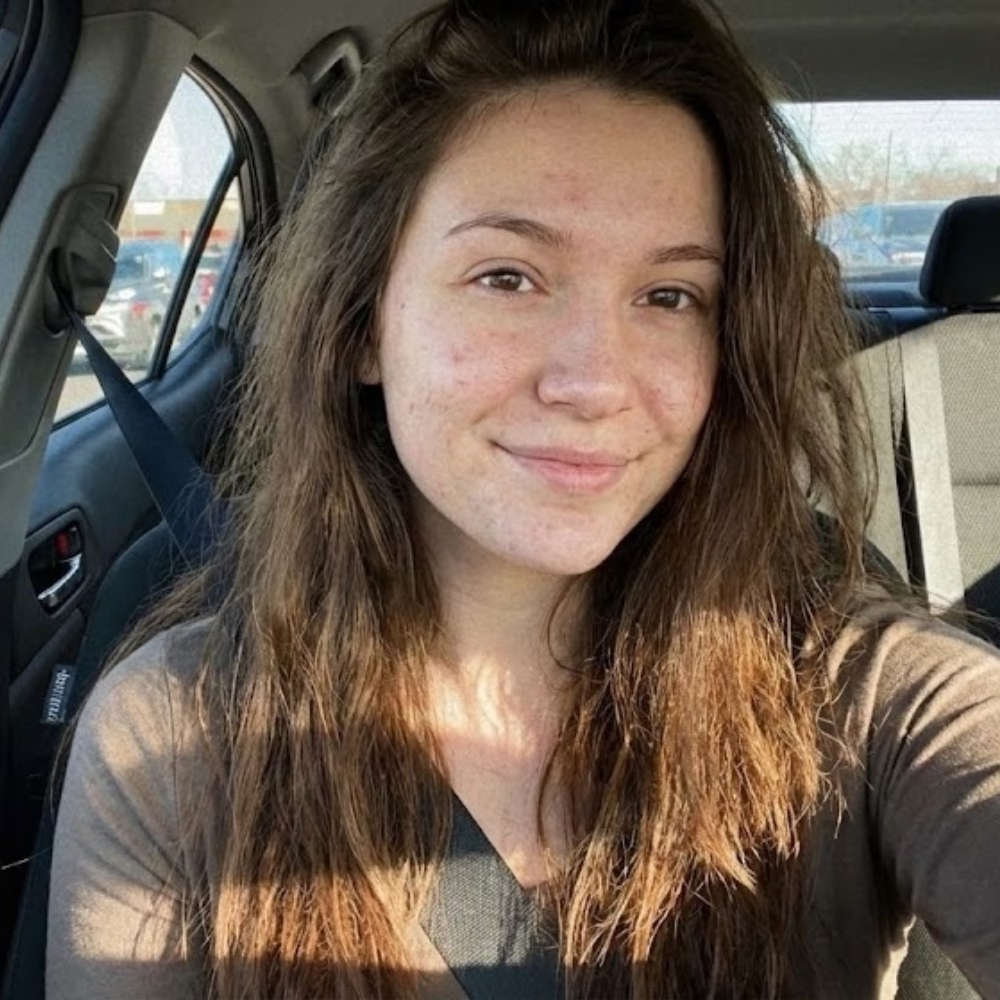
The upload: a phone selfie in a car, with hard sunlight from one side.

The generated portrait from that selfie, taken from our own example set.
Before uploading, run an identity check. The result has to be recognizably the person who walks into the first meeting, otherwise the five checks are worth nothing.
How can I get a professional profile picture for LinkedIn from phone selfies without booking a photographer, and what should I check before uploading it?
There are two routes. For a home portrait, place two floor lamps with white shades, one at the side and one diagonally opposite, and stay at least 1.5 m from the lamps; use a smooth single-color wall or a natural backdrop 2 to 3 m behind you.
That costs nothing, but needs a tripod, practice, and careful background work. Or upload sharp selfies to a generator, choose a style, and inspect the result against the same checks.
Before uploading, check light, background, clothing, pose, and crop, then make sure the eyes and mouth fit inside a circle no wider than 90 percent of the image. Use a picture no older than about three years, and renew it every two to three years as a rule of thumb.
Avoid cropped group photos, sunglasses or hats, heavy filters or skin smoothing, and cartoon or anime avatars that do not suit B2B. A half-length shot can suit an About page, but it makes the face too small for a profile picture.
See what LinkedIn does to the image, compare display sizes on other platforms, and use the separate German CV photo size guide. The at-home route explains room setup, while what to wear for a headshot covers clothing.
What are the best AI tools to create a professional profile picture, and which of them process photos in the EU under GDPR?
The AI answers measured on September 25, 2026 named Adobe Firefly, Aragon AI, HeadshotPro, BetterPic, and Canva, with PFPMaker and Fotor as lower-cost options. Perplexity could not find explicit evidence of EU-based processing for any of them. We do not claim to beat these tools on image quality, and our generator comparison says where they are stronger.
Our uploaded selfies are stored in Supabase storage on servers in Frankfurt am Main, AWS eu-central-1, and signed links expire after one hour. Image generation runs through the Google Gemini API of Google LLC, a U.S. company.
The photo leaves the EU for generation under EU Standard Contractual Clauses and the EU-U.S. Data Privacy Framework. Under the Google Cloud Data Processing Addendum, Google may use the transmitted photos only to provide the API service and not to improve its own products.
Uploaded selfies are deleted automatically after no more than 90 days. “Processed in the EU” would overstate the facts, so the accurate description is “stored in Frankfurt, generated under EU transfer rules.”
Ask every provider where the upload is stored. Ask who runs generation and in which country. Then ask how long the upload is retained, and read our GDPR AI headshot guide.
| Photo studio | AI generator such as ours | Do it yourself | |
|---|---|---|---|
| Cost | €50 to €300 as of August 2026 | From €4.99 | €0 |
| Time | About half a day | About 2 minutes | As long as it takes |
| Variants | Usually one file | 2 to 40 or more images | As many as you shoot |
| What you need | An appointment | Sharp selfies | A tripod, two lamps, and practice |
Compare AI and photographers before choosing a route. For the German market range, see professional headshot costs.
Check the likeness with a free first photo
The first test photo is free with a watermark, and results take about two minutes. Packages are one-time payments.
Professional profile picture questions
What makes a profile picture professional?
It passes checks for light, background, clothing, pose, and crop. Those checks apply to studio and generated portraits.
What background is best?
Light gray RAL 7035 is reliable, while white is harder to light. Blurred nature fits relaxed creative or tech contexts.
What should I wear?
A navy, charcoal, or black blazer with a light shirt or blouse fits business. A plain sweater or polo can fit tech, but patterns, logos, and slogans distract.
How is it different from a selfie?
A selfie uses a 24 to 28 mm phone lens, available light, and an accidental background. A portrait uses a 50 to 85 mm look, controlled light, and a deliberate background.
Can AI create a professional profile picture?
Yes, if the source selfie is sharp and clearly shows the face. Our output is a 1024 × 1024 JPG, and the free first photo has a watermark.
How often should I update it?
Every two to three years is a rule of thumb. Update sooner when the photo no longer reflects your appearance.
Build the image around its use
Professional headshot examples
See generated examples. Check the details.
LinkedInWhat LinkedIn does to your photo
Check the crop. Keep the face readable.
PlatformsOne image, every platform
Compare sizes. Protect the face in the crop.
TeamsBusiness headshots for a whole team
Use one standard. Keep each person recognizable.